Why yes indeed.
On the way back from Pompeii darkness had descended upon us and the walk from the train station in Naples to the hotel took on a slightly more sinister spin.
The days rain had washed the sidewalks clear of most of the filth and grime that usually be-speckled them in the manner of a Jackson Pollock painting. The air was think and humid, and fugged with the chunky smells of Naples; the sea, car exhaust, hot bread, decomposition (of many-many things), old fish and new rubber, occasionally just a hint of burnt hair/plastic/tin.
Halfway up the Corso Umberto I we found a dumpster on fire. The odd thing about it was the simple fact that people were trying to ignore it, like one tries to ignore a screaming child on an airplane. Finally a gentleman (I use the term loosely) very casually sauntered out of his store with a bucket of water and poured it in the dumpster. When this failed to put out the fire he walked back into his store with a look of complete disinterest.
Eventually we moved on. the next day we found the burnt out dumpster and the charred tree above it looking rather sad.
As they say, when you tire of Naples you can get shanked by the docks.
Thursday, July 19, 2012
Thursday, July 12, 2012
Pompeii - December 30, 2011 - Villa of the Mysteries
| Inside Villa of the Mysteries |
| Villa of the Mysteries |
This villa appears in almost every book on Roman art because of a fresco that flows around one of the rooms in an immense and impressive cycle. The painting is thought to represent the rites of the cult of Dionysius, a cult whose wild abandon and ecstasies during celebrations were shunned and eventually banned by the earlier more conservative Rome of the republic.
| The room of the mysteries in the Villa of the Mysteries |
We did eventually find the room and I was taken aback by how vibrant and clear the paintings still are after nearly two thousand years buried in ash.
I read somewhere that the villa had been abandoned after the earthquake of 62 AD, though I am not sure where I read that and it seems somewhat unlikely if the house was in relatively good condition.
The exit from here leads out of the Pompeii archeological site and onto a rather pleasant road that winded and twisted and wound its way down to the train station....eventually. It was about a twenty-five or thirty minute walk and there were a number of times that I thought we were lost. As a delightful post script a driver deliberately drove through a puddle of mud that splashed us from head to toe. YAY! Italy in December.
| Small Atrium in the Villa of the Mysteries |
Pompeii - December 30, 2011 - Forum Baths
| Frigidarium, cold bath |
| Ceiling of the tepidarium, warm bath |
The forum baths are near, you guessed it, the forum. It really easy to miss as it lacks the
grandeur and size of the late second century baths in Rome. The entrance is
actually down a small passageway from a normal looking door in the wall.
The interior is remarkably well preserved with the tepidarium
and the caldarium being the most incredible.
There was a crowd of people at the entrance to the frigidarium and I almost didn't go over and look. Glad I did though, the interplay of the circles and arches is quite lovely.
| Cold water fountain in the caldarium |
| Barrel vaulted caldarium |
Pompeii - December 30, 2011 - Tombs
| Tomb of M. Porcius |
| Unnamed tomb |
Heading north out of Pompeii by
the Herculaneum gate one can visit dozens of tombs along the ancient road.
There are also the distractions of the
villas of Cicero and Diomedes, both were closed to the public when we passed
through, though I did scramble up an embankment off the side of the road an
take a quick snapshot through the gates.
There also are quite a number of shops and
workshops along this road. It’s almost like a shopping mall; outside the main
city gates (suburban), all together in a couple of giant uniform looking
buildings. I have a friend that says there is nothing new to be found in the
world (rather a pessimist really) but seeing this sort of thing makes it seem
true.
| Tomb or public bench? |
There are a number of small tombs, large
tombs, tombs in the shape of semi-circular benches, a round tomb and a couple
of triclinium tombs where the relatives of the deceased could come and have a
picnic…of sorts. The most delightful of these still has some of the interior
painting and does not have a name associated with it leading some to believe it
was actually built as a public bench.
The next time I am waiting for the bus in a plastic bus shelter with the
lingering acrid smell of someone’s “overindulgence” I’ll think of this place.
One of the more impressive (just due to the
surviving amount of marble covering) is the tomb of Calventius Quietus, also
located on the west side of the road. It has a large altar shaped top with some
lovely carving, wreaths, ribbons and the like.
The tomb of M. Popidius is at the fork in
the road where the left side leads to the villa of the mysteries and the right
side leads to….not sure. But I am sure it leads somewhere.
The road itself is quite impressive, being the original Roman road. The stones are so smooth! Polished by feet and sandals millennia ago.
Below is part of the arcade in front of the shops along the east side of the road leading north out of Pompeii by the Herculaneum gate. Below that is the picture I was able to capture of the Villa of Diamedes.
| Suburban shopping, rocking it ancient style |
| Villa of Diomedes, near Herculaneum gate |
Friday, July 6, 2012
Pompeii - December 30, 2011, Shops, Fullers and Bakers
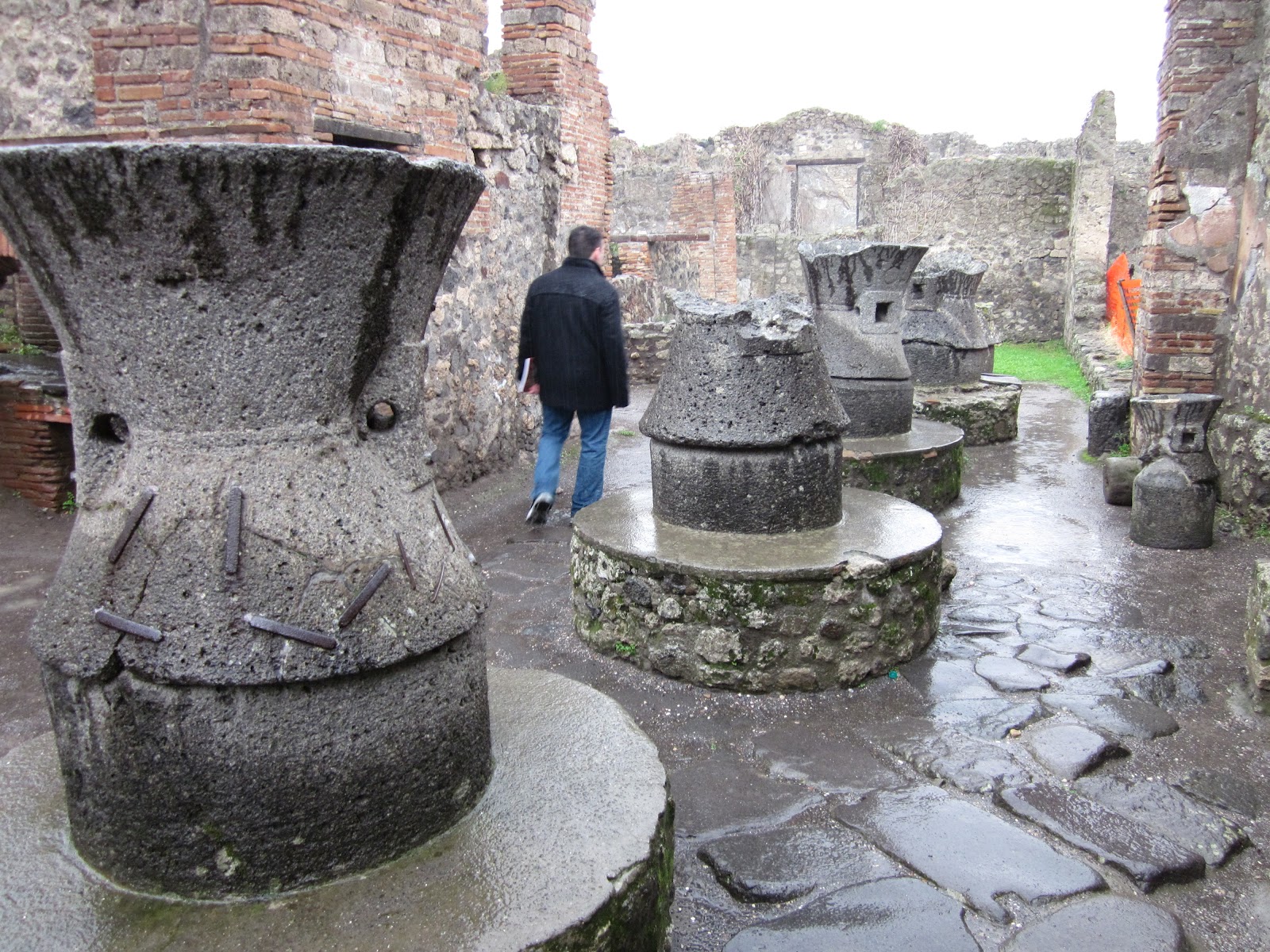
| Mill stones at a large bakery in Pompeii |
The bakeries have some pretty impressive looking millstones.
You can tell where a wooden shaft could be inserted to attach to an animal or
maybe some slaves? It all sounds rather gruesome and grueling work for man or
beast.
There was one fullers workshop that we found that was identified as such and was open. It was converted out of an older, and rather nice, house in the center of town. Perhaps the original owners had fallen on bad times and sold it? Or maybe they moved a little further out of the center of town? There wasn’t really a separation between commercial and non
| Thermopolium in the "Theatre District" |
It was tagged the Fullonica di Stephanus and was rather an impressive ruin.One of the few in Pompeii that had much of the second story's masonry intact. This included a lovely row of columns on the second floor.
| Fullonica di Stephanus |
Pompeii - December 30, 2011 - Streets
| Street in Pompeii |
The sidewalks appear to be extraordinarily high off of the
surface of the road when compared with modern sidewalks (and ADA requirements). This is because there wasn’t a complex sewer
system for carrying away waste water, or just waste in general. Without a system like Rome's fantastic Cloaca Maxima waste flowed (on good days) in the streets much like Cleveland. Which
just adds a new perspective on how different modern Pompeii is from 2000 years
ago. It also makes it very clear why the great stepping stones were so
necessary at so many of the street intersections.
Pompeii - December 30, 2011 - Temple of Vespasian
| Altar with Vespasian (on the left with head covered) |
Right on the forum next to the Building of Eumachia is
another building dedicated to the imperial cult; the Temple of Vespasian. Has a
magnificent white marble altar with bas reliefs showing the emperor as priest
offering sacrifices to the gods.
The brickwork walls were covered with decorative plaster. This is long gone however the bricks were built up in such a way as to provide a basic form. The alternating triangular and curved pediments might be most familiar to Americans as being devices used on the White House.
The temple was built sometime after the earthquake of 62 AD
and must have been dedicated before the emperors death as Vespasian died only a
few short months before the eruption.
His son Titus became emperor upon his death, being (I believe) the first natural, not adopted, son of an emperor to inherit the empire.
Titus however, did not wear the purple for long, just a few years. His younger brother Domitian was just a little too devious and had Titus packed into a chest of ice to cool his fever. It did all too well, very soon he was cold dead. Domitian would go on to build a massive palace on the Palatine Hill (which incidentally is where we get the word "palace") and then would be murdered in said palace by court officials.
| Temple of Vespasian - Court, Alter and Cella |
Subscribe to:
Posts (Atom)