Showing posts with label Pompeii. Show all posts

Thursday, July 12, 2012

Pompeii - December 30, 2011 - Villa of the Mysteries

Inside Villa of the Mysteries
Villa of the Mysteries
A short walk from the tombs and the Herculaneum gate lies the Villa of the Mysteries. Framed by a wall of trailing rosemary the building is well preserved and has been very carefully reconstructed. So much so that it looks like with a few trips to IKEA and some updated plumbing, one could move right in.

This villa appears in almost every book on Roman art because of a fresco that flows around one of the rooms in an immense and impressive cycle. The painting is thought to represent the rites of the cult of Dionysius, a cult whose wild abandon and ecstasies during celebrations were shunned and eventually banned by the earlier more conservative Rome of the republic.

The room of the mysteries in the Villa of the Mysteries
Once inside the villa getting to the fresco was not as easy as one would think. The floor plan is rather maze like and we ended up in the same peristyle three times going around in circles until I finally spotted a German tourist who was also in search of this room. It’s funny I have looked at the floor plan of this house for decades, I know where the room is, however translating that knowledge into 3-D is rather difficult.

We did eventually find the room and I was taken aback by how vibrant and clear the paintings still are after nearly two thousand years buried in ash.

I read somewhere that the villa had been abandoned after the earthquake of 62 AD, though I am not sure where I read that and it seems somewhat unlikely if the house was in relatively good condition.

The exit from here leads out of the Pompeii archeological site and onto a rather pleasant road that winded and twisted and wound its way down to the train station....eventually. It was about a twenty-five or thirty minute walk and there were a number of times that I thought we were lost. As a delightful post script a driver deliberately drove through a puddle of mud that splashed us from head to toe. YAY! Italy in December.

Small Atrium in the Villa of the Mysteries

Pompeii - December 30, 2011 - Forum Baths


Frigidarium, cold bath
Ceiling of the tepidarium, warm bath
The forum baths are near, you guessed it, the forum.  It really easy to miss as it lacks the grandeur and size of the late second century baths in Rome. The entrance is actually down a small passageway from a normal looking door in the wall.

The interior is remarkably well preserved with the tepidarium and the caldarium being the most incredible.

There was a crowd of people at the entrance to the frigidarium and I almost didn't go over and look. Glad I did though, the interplay of the circles and arches is quite lovely. 


Cold water fountain in the caldarium

Barrel vaulted caldarium
.

Detail of the plasterwork in the tepidarium
 

Pompeii - December 30, 2011 - Tombs


Tomb of M. Porcius
Unnamed tomb
Heading north out of Pompeii by the Herculaneum gate one can visit dozens of tombs along the ancient road.

There are also the distractions of the villas of Cicero and Diomedes, both were closed to the public when we passed through, though I did scramble up an embankment off the side of the road an take a quick snapshot through the gates.

There also are quite a number of shops and workshops along this road. It’s almost like a shopping mall; outside the main city gates (suburban), all together in a couple of giant uniform looking buildings. I have a friend that says there is nothing new to be found in the world (rather a pessimist really) but seeing this sort of thing makes it seem true.

Tomb or public bench?
On the west side of the road are some impressive remains.  The tomb of M. Porcius rises in the rear with its three reconstructed columns a ghostly silhouette against the sky.

There are a number of small tombs, large tombs, tombs in the shape of semi-circular benches, a round tomb and a couple of triclinium tombs where the relatives of the deceased could come and have a picnic…of sorts. The most delightful of these still has some of the interior painting and does not have a name associated with it leading some to believe it was actually built as a public bench.  The next time I am waiting for the bus in a plastic bus shelter with the lingering acrid smell of someone’s “overindulgence” I’ll think of this place.

One of the more impressive (just due to the surviving amount of marble covering) is the tomb of Calventius Quietus, also located on the west side of the road. It has a large altar shaped top with some lovely carving, wreaths, ribbons and the like.

The tomb of M. Popidius is at the fork in the road where the left side leads to the villa of the mysteries and the right side leads to….not sure. But I am sure it leads somewhere.

The road itself is quite impressive, being the original Roman road. The stones are so smooth! Polished by feet and sandals millennia ago. 

Below is part of the arcade in front of the shops along the east side of the road leading north out of Pompeii by the Herculaneum  gate. Below that is the picture I was able to capture of the Villa of Diamedes.

Suburban shopping, rocking it ancient style
Villa of Diomedes, near Herculaneum gate


Friday, July 6, 2012

Pompeii - December 30, 2011, Shops, Fullers and Bakers


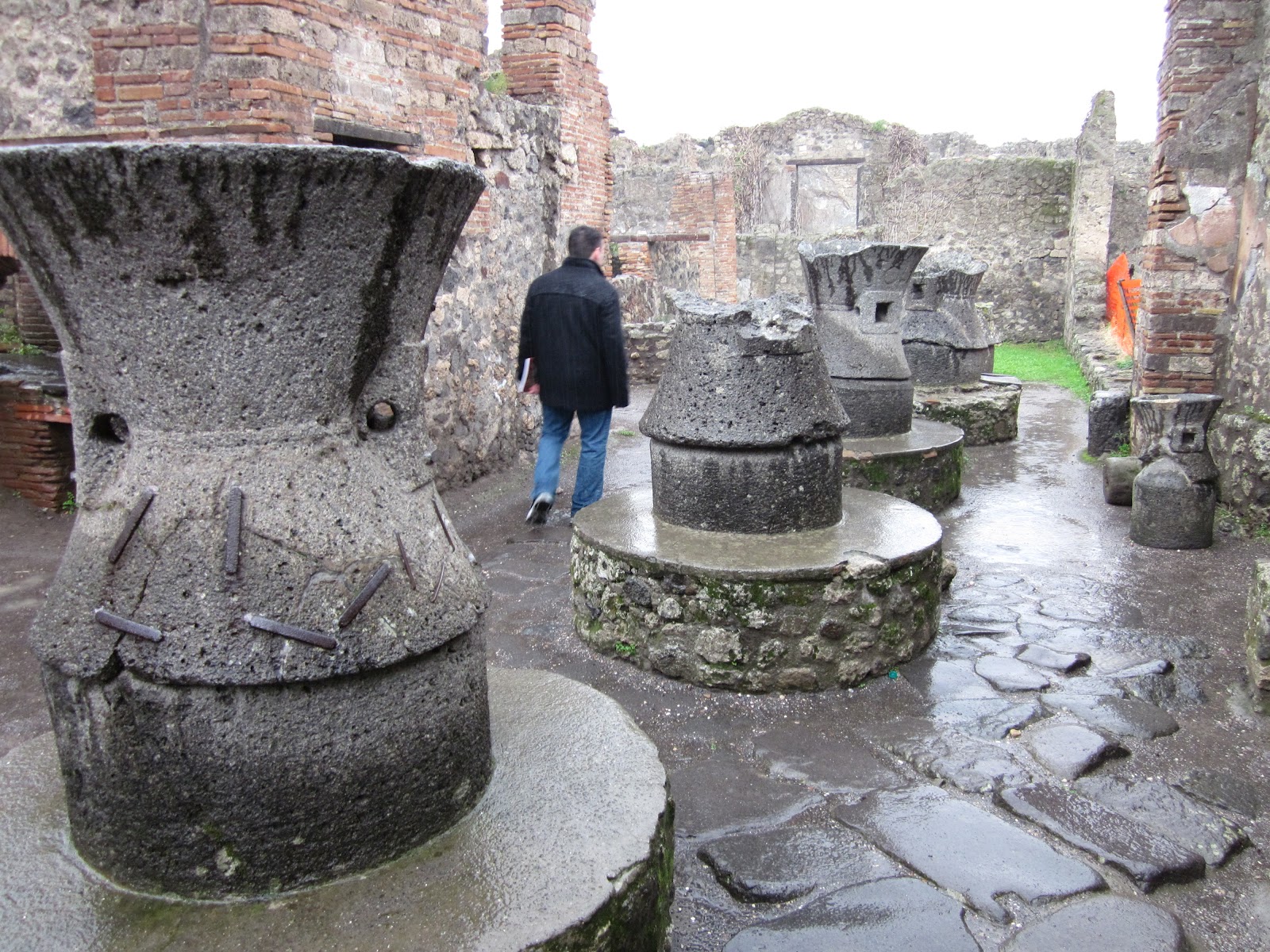
Mill stones at a large bakery in Pompeii

There are lots of the little shops that have counters made out of inlaid marble shards. Most if not all of them have large terracotta jars set into them. See the Thermopolium of Lucretius  for more information on one of the best preserved ones. 

The bakeries have some pretty impressive looking millstones. You can tell where a wooden shaft could be inserted to attach to an animal or maybe some slaves? It all sounds rather gruesome and grueling work for man or beast.


There was one fullers  workshop that we found that was identified as such and was open. It was converted out of an older, and rather nice, house in the center of town. Perhaps the original owners had fallen on bad times and sold it? Or maybe they moved a little further out of the center of town? There wasn’t really a separation between commercial and non
Thermopolium in the "Theatre District"
commercial activities in the average Roman town. So unless they were moving to Herculaneum (which had more of a resort feel to it) or to a larger villa outside of the city walls, I have to think that the original owners fell on hard times or died out.

It was tagged the Fullonica di Stephanus and was rather an impressive ruin.One of the few in Pompeii that had much of the second story's masonry intact. This included a lovely row of columns on the second floor. 

Fullonica di Stephanus

Pompeii - December 30, 2011 - Streets

Street in Pompeii
The streets of Pompeii are bleak.  The ruinous nature of the landscape the lack of second stories (for the most part) and in winter a lack of tourists all add to this impression. Yes,  it is the site of a cataclysmic disaster and one would expect it to be a little solemn.  With all of the plaster and paint missing from the mounds and piles of bricks that used to be shops, houses and places of worship even at ground level you are not really seeing the city as Pompeian’s would have 2000 years ago.  Six quadrillion tons of hot ash will do that.

The sidewalks appear to be extraordinarily high off of the surface of the road when compared with modern sidewalks (and ADA requirements). This is because there wasn’t a complex sewer system for carrying away waste water, or just waste in general.  Without a system like Rome's fantastic Cloaca Maxima waste flowed (on good days) in the streets much like Cleveland. Which just adds a new perspective on how different modern Pompeii is from 2000 years ago. It also makes it very clear why the great stepping stones were so necessary at so many of the street intersections.

Stepping Stones with wagon ruts
While walking  around look for the little tiles set into the ground. These were reflectors of moonlight, torch of candle light to aid pedestrians of the night and stop them from falling into the street full of doo-doo feces. Which would just be horribly unpleasant.

Pompeii - December 30, 2011 - Temple of Vespasian


Altar with Vespasian (on the left with head covered)


Right on the forum next to the Building of Eumachia is another building dedicated to the imperial cult; the Temple of Vespasian. Has a magnificent white marble altar with bas reliefs showing the emperor as priest offering sacrifices to the gods. 

The brickwork walls were covered with decorative plaster. This is long gone however the bricks were built up in such a way as to provide a basic form. The alternating triangular and curved pediments might be most familiar to Americans as being devices used on the White House. 

The temple was built sometime after the earthquake of 62 AD and must have been dedicated before the emperors death as Vespasian died only a few short months before the eruption. 

His son Titus became emperor upon his death, being (I believe) the first natural, not adopted, son of an emperor to inherit the empire. 

Titus however, did not wear the purple for long, just a few years. His younger brother Domitian was just a little too devious and had Titus packed into a chest of ice to cool his fever. It did all too well, very soon he was cold dead. Domitian would go on to build a massive palace on the Palatine Hill (which incidentally is where we get the word "palace") and then would be murdered in said palace by court officials.
Temple of Vespasian - Court, Alter and Cella


Tuesday, June 26, 2012

Pompeii - Temple of Isis - December 30, 2011

Lex, bad moustachioed mode
In the “Theatre District” of Pompeii is a sacred enclosure of a small and intimate nature. This contains the exquisite jewel that is the Temple of Isis. Isis was a goddess of Egyptian origin whose worship spread throughout the Greco-Roman world after the empire of Alexander the Great fell apart upon his death. She was apparently very popular in Pompeii and Herculaneum as scenes depicting Isian rituals appear in numerous private residences throughout the two cities.

Temple of Isis
Completely rebuilt after the earthquake of 62 AD it is a fascinating moment in architecture. The temple, enclosure walls, columns and shrine for holy Nile water were all constructed out of brick and then liberally covered with a layer of stucco treated in many different ways. There are panels reminiscent of wainscoting, raised molded figures, fluted columns, square pilasters, friezes, niches, dolphins, garlands and all manner of devices executed in stucco. Surprisingly there are traces of paint on many portions.

The temple building consists of a very small cella on a raised platform with two flanking wings, that are only as deep as the niches they contain. Four columns of tufa in front of the cella supported a pediment that is no longer extant. The stucco on the temple proper is scored to look like dressed stone.

Rear of Temple of Isis
Sacred Nile Water Shrine
Next to the altar in front of the temple there is a little building with some enchanting decoration. This was to house the sacred Nile water and it is delightfully detailed, there are some lovely dolphins and winged humanoids on the side. It reminds me of the higher class of garden shed or summer house found in the gardens of English country houses.

To say the least I was very-very-very happy to finally get to visit this temple. After reading about it and the worship of Isis for decades it was anything but anticlimactic. Nothing had prepared me for the level of preservation I found at the site. And, though it had taken many hours of wandering to get there, this was, for me, the climax (or so I thought...the forum baths were open and they are divine! more divine than a temple? Maybe. More people went to the baths than the Temple of Isis. I wish it were the same today sometimes.).

Below is a picture of the forecourt and the small stucco shrine for the Holy Nile Water. 

Forecourt of the Temple of Isis showing the altar (without it's marble cladding) and the stucco shrine of the holy Nile water.


Monday, June 25, 2012

Pompeii - Temple of Apollo


Sacred enclosure of the Temple of Apollo, altar
There has been a temple of Apollo here since the beginning of time. Literally. Well at least since the 5th or 6th century BC.  The current one dates from somewhere in the middle of the 2nd century BC, putting it around the same time period as the temples at the ForumBoararium in Rome.

This one was in the Doric manner with columns all the way around, while being set on a raised platform in the more Roman fashion.  The temple is set in the center of a good sized peristyle of fluted columns. These along with the temple itself were damaged in the earthquake in 62 AD and were still undergoing restoration at the time of the great cataclysm seventeen years later. 

The ancient restoration efforts are still very visible and it reminds me of modern times; in that they were replacing the plain, solid and sturdy  volcanic rock columns with flimsy columns made out of brick covered in stucco and topped off with highly elaborate Corinthian capitals. These would have all been painted in garish colours with a taste reminiscent of a 19th century western bordello.

Statue of Apollo
Apollo and peristyle
The statue of Apollo the archer is a copy (the real one is in Naples) but still very dramatic.He is missing his bow, which I am sure must make him very self conscious. The statue of Diana I wrote about briefly in an earlier post is also in the sacred enclosure.

The remains of a spectacular marble altar are standing in front of the temple near the steps. It has survived well and looks like it is screaming to be smothered in animal entrails! It's possibly for this reason that the central part of the enclosure is fenced off.

The other item of great interest is a tall freestanding ionic column of white marble that supports a sundial. Standing to the left of the stairs leading into the temple proper this gloriously preserved sundial was donated by the same gentlemen that donated the semi-circular bench by the temple in the triangular forum. Now they would have a hospital wing named after them. In the first century AD it was benches and sundials.

Super duper sundial in the sacred enclosure of the Temple of Apollo

Monday, June 18, 2012

Pompeii - December 30, 2012 - Eumachia and her building


Statue of Eumachia
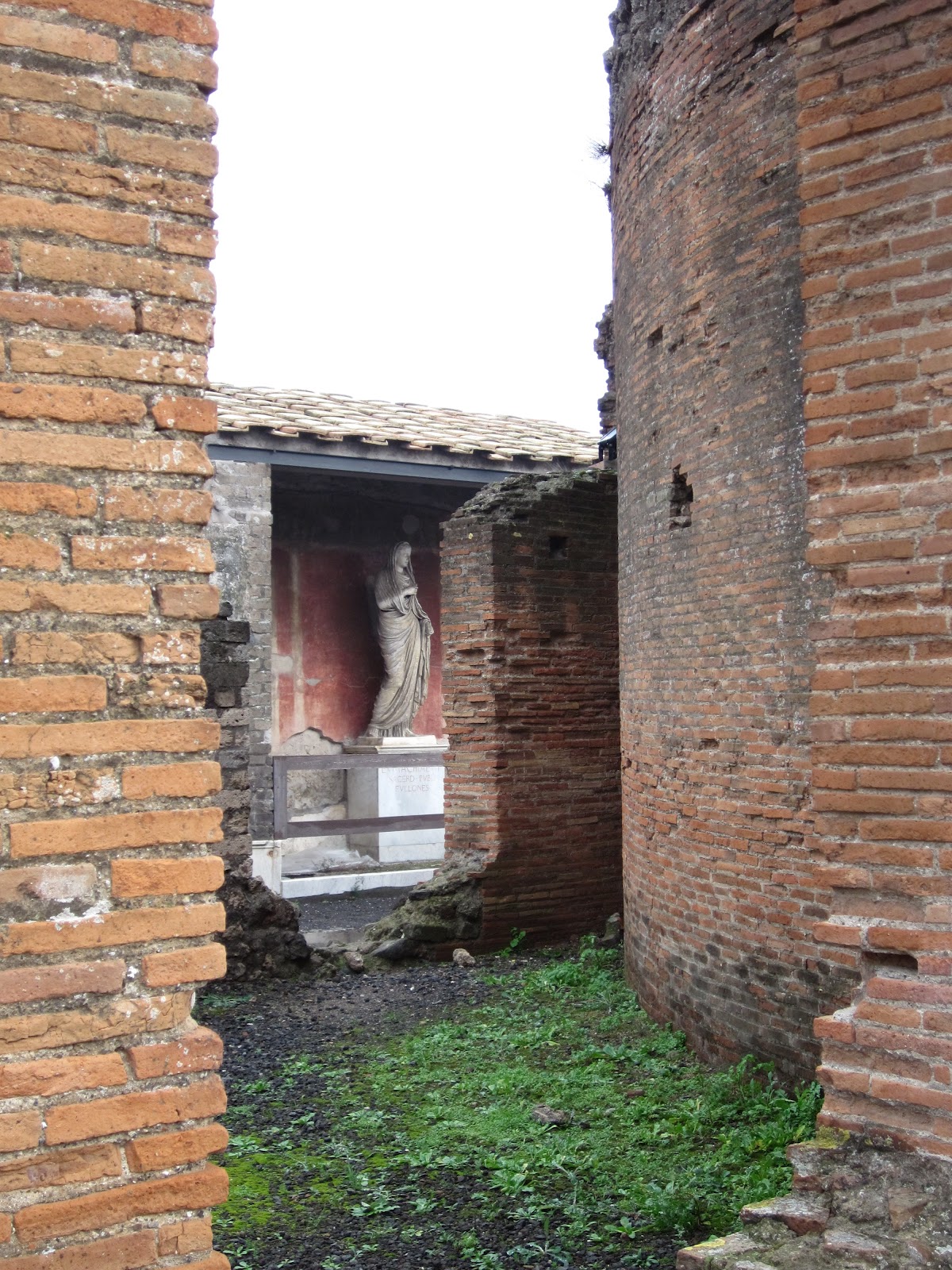
Eumachia was a rather wealthy woman; we can tell this because she built one of the largest public buildings in Pompeii with her own funds.  We know that she was a priestess of the Pompeian Venus and matron of the Concordia Augustus, we know that she had a son, we don’t know which house she lived in or what the source of her great wealth was.  Presumably something to do with the fullers (people who cleanse wool through the process of fulling), as the building she built served as the guild house for the fullers and the fullers of Pompeii dedicated a statue of her as a patron.

The door frame that opens onto the forum is incredibly elaborate, so much so that it has been encased in acrylic to preserve it. However this does make it a little hard to see. Her statue (or a facsimile) is still on a plinth at the rear of the building. A very nice statue, lots of realistic  flowing drapery depicts her veiled as a priestess (much like the altar in the Temple of Vespasian, shows him as a priest). The base of the statue carries the inscription from the fullers who were very grateful for such a high class building.

Thursday, June 14, 2012

Pompeii - December 30, 2011 - Macellum


Macellum with the central pavilion clearly visable
 The Macellum or Market was a hub o activity right off the forum.  The entrance is still rather impressive even though only one story survived the eruption.

IN the center of the market are twelve stone bases made of volcanic rock. Originally it is supposed that they supported wooden columns of some type that in turn supported a wooden roof. Much has been made of the fact that copious amounts of fish bones were found here so presumably the covered area was where fish was sold.

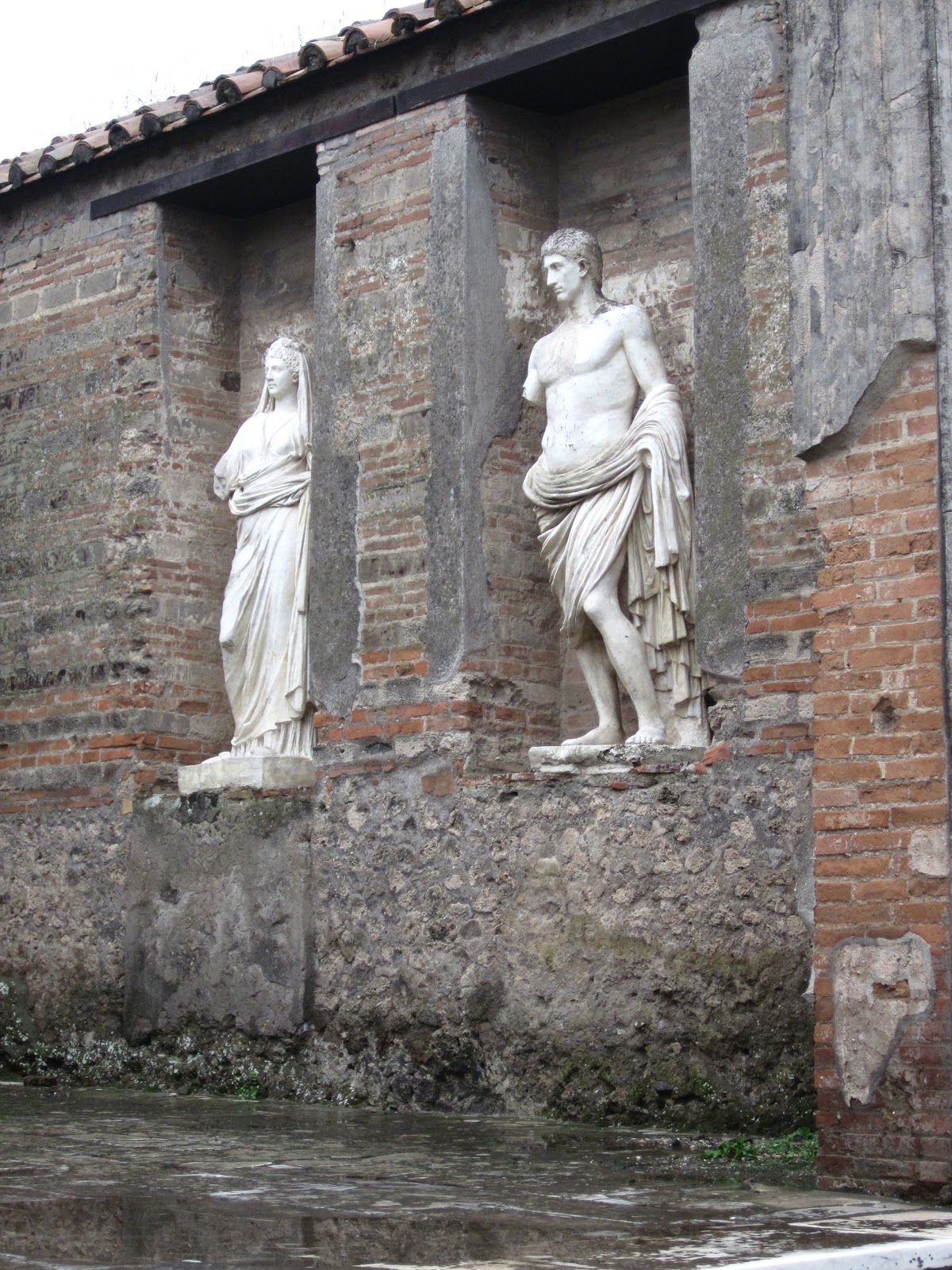
At the rear of the market are three rooms. The central one raised up on a number of steps is a shrine to the Imperial Cult. Copies of the statues found here have been placed in the niches at the sides. With the harsh brick lacking its original stucco decoration the statues look a little out of place.  A little, tacky, a little Las Vegas or Atlantic City. 
Shrine to the Imperial Cult
Atlantic City?

The stairs to the shrine are really well preserved.

Some of the store rooms mentioned in the Artifact Storage post  are located along the south side of the macellum near the entrance from the forum.


Pompeii - December 30, 2011 - Artifact Storage


There are a couple of sheds full of unearthed artifacts that we apparenly not of enough interest to be carted off to the Museum in Naples.  right off the forum.

Mostly household, or everyday items. Lots of terracotta and innumerable fragments.

These big covered storage areas are lined with shelves each one crammed with the detritus of everyday life. There  are stacks of bright colourful plastic boxes are filled with smaller fragments while on the floor are lined up hundreds, no,  thousands of amphorae.  Above these fat jars, kraters, bits of marble sculpture and bronze. The aisles in-between the shelves are scattered with garden sculptures, marble tables, columns,  terracotta roof decorations and tragically a number of the victims of the eruption preserved in plaster and encased in glass cases. 

A morbidly fascinating display disturbingly reminiscent of the devils Costco.


Tuesday, June 12, 2012

Pompeii - House of the Tragic Poet

The house of the tragic poet was closed during our visit to Pompeii. However the famous mosaic of a guard dog is in the vestibule and visible close up through the bars of the gate.

“Cave canem” means beware of the dog. Now I am not sure if this was a pun, based on the fact that the mosaic is of a very high quality with a rather realistic looking dog; “Beware of the mosaic dog”, which could be funny if one had the type of mind that finds humor in such situations. It also could be a very real warning; “Beware of the dog because he is vicious and half starved and rips burglars in half and chews on their eyeballs”. The house is known for the richness and high quality of its decoration, so it is distinctly possible that the owners had a guard dog to protect their hoarded treasure.

The house has been made famous in numerous books and movies (Last Days of Pompeii, etc…) but as it was closed I was unable to check the veracity of those accounts. Onward…

Pompeii - House of Menander

Menander
Atrium near tabulium
Another of the delights of Pompeii.

This house has been a bit reconstructed, however the quality of the surviving paintings is extraordinary.


The name comes from a painting of a writer found on one of the walls, most often identified as Menander. Delightful house, a bit of plumbing work and clearing up some of the damp and I’d be happy to move in. Over 100 pieces of silver dinnerware were found here during excavations, though I think it’s all back in Naples right now. 

House of Menander, Atrium
Menander was a Greek playwright possibly best known to the modern reader for the comedic play Dyskolos, which I believe is the only one of his works to survive in a near enough complete state as to make translation possible. You can actually read a translation here. Personally I like The Frogs much better. Plutarch also mentions that the phrase “Alea iacta est”, most famously quoted “Terminator style” by Julius Caesar as he was crossing the Rubicon, came from one of Menander’s plays. Caesar always gets the best catchphrases, one has to wonder if he had a writer
come up with a steady stream of them? Otherwise I’m ure we would end up with such-phrases as “Veni, vidi, vomo” (I came, I saw, I barfed), phrases that silly little school boys come up with in Latin class and laugh about non-stop. I should know, I certainly did.

Peristyle and garden
The atrium is well preserved and the temple to the Lares (or household gods) made me squeal with delight. Which, I have been told was pretty comical in a grown man with a handlebar mustache.


The impluvium is well preserved as are the columns flanking the tablinium that leads to the peristyle and garden. The latter has been recreated with an eye towards historical accuracy, as far as I have
 Household shrine and stairs
been told! looks like boxwood to me, but I tend to have a black thumb when it comes to plants so I try not to get too close.  Having the roof restored makes this a really nice spot to get out of the rain or the sun, depending on the time of year one is visiting.

Other houses in Pompeii, such as the House of the Faun, or the House of Pansa, might be significantly larger, but they are quite obviously ruins. The House of Menander is presented in such an incredible state of preservation and restoration that life in the first century AD becomes quite imaginable. And, I suppose, livable; as long as you were the one that owned the house and not the one that had to empty the slop buckets. Which is still gross, and one of the reasons I hate camping, now where did that rant come from?


Peristyle and garden with roof over atrium


Saturday, June 9, 2012

Pompeii - Themopolium of Lucius Vetutius Placidus

Themopolium of Lucius Vetutius Placidus: I know very little about this place other than the fact that it was the Roman equivalent of a fast food restaurant. There are quite a number throughout Pompeii, but most not as well preserved as this. It has a rather famous painting at one end of the bar. At least famous enough to have ended up in a number of books on Pompeii and Roman painting. The big terracotta jars set into the counter would have held foodstuffs and wine (the wine most likely mixed with honey and or spices, Roman wine was a bit more “Night Train” than “Chateauneuf-du-Pape”).

If you are interesting in trying out a few ancient Roman recipes there is an English translation of Apicius (Apicius: Cookery and Dining in Ancient Rome) which one can (with a little guessing on the quantities) create some authentic ancient Roman cuisine. I have been playing with this on and off for twenty years and once went as far as to serve a dinner of over 30 dishes recreated from this book. It was a heck of an undertaking, and I cannot state that every dish was as ambrosia to the Gods, but some were excellent!

There were dozens of shops like this all over Pompeii, with a high concentration towards the north west portion of the city towards the 


Pompeii - Amphitheatre

Pompeii Amphitheatre, first view
Standing in the farthest south east corner of the city, the amphitheatre in Pompeii is impressive, even though just two days before I have been standing in the coliseum  in Rome the amphitheatre in Pompeii is grand. It lacks much of the complicated vaulting and substructure of the coliseum however it predates it by over a hundred years.

This is the oldest surviving amphitheatre in the ancient world and it is very practical and elegant in its simplicity. It may not have the decor and flourishes of the amphitheatre in Arles or Verona, but its the oldest of the bunch. 

It is oval in shape and consists of dozens of arches supporting the seating for thousands of spectators. There are a number of entrances that lead straight to the floor of the arena and a magnificent staircase also supported by arches.

Amphitheatre inside, nice brickwork
Standing in the arena in the rain it does seem a little forlorn. It’s hard to imagine the clash of weapons and the blood and sweat of hand to hand gladiatorial combat while chewing on an energy bar in the grey drizzle of late December.

In AD 59 a riot broke out during some games that involved a rival town. Next thing you know half the police chariots have been overturned and a bunch of people have accidentally been stabbed to death. Soccer riots first century style.  Because of this little tussle, games were banned from being held in Pompeii for ten years. However good old Nero had the games reinstated not too long after the incident because his most recent wife was from the area and even an emperor wants to be on the good side of his in-laws. That is of course until one grows weary of them and has them all smothered to death during Saturnalia dinner (dramatization, I don’t think he ever did that). 

I'll leave you with a view from the floor of the area where so much blood was spilled, like cheap beer at a frat party. 

Pompeii amphitheater