Friday, September 21, 2012

Naples - Gesu Nuovo


Gesu Nuovo: Consecrated by the Jesuits in 1601this is a rather unique church in Naples. 

The facade is fascinating. It looks unfinished, as if it is lacking a pediment. The giant c-scrolls in piperno stone seem prepared to support something a little more grand than nothing.  The strange pyramidal ashlar work on the facade is, well strange, compared to the fluid and flamboyant architecture that abounds in Naples. The stone is very dark and gives the building a prison like air. If it were not of the three marble trimmed baroque portals and the same number of marble trimmed baroque windows inserted into the facade it would be exceedingly bleak. The central portal is quite a work of art with only two cherubs and two reclining figures, and a cartouche and some scroll work and some bass reliefs. 

The strange apperance is apparently from the fact that the church was built as a palace in the fourteenth century. Not sure exactly how it became a church. But I think that anything left in Naples for long enough will become a church. 

On an interesting note, we saw a palace in Rome that had very similar pyramidal ashlar work and the Faceted Palace at the Kremlin in Moscow (designed around the same time by an Italian architect) has much the same finish.  I remember reading when I was there that the architects that had worked on the Kermlin had come from Italy. It is very possible that they had seen this building. 


Saturday, August 18, 2012

Naples - Guglia - Piazza Gesu Nuovo

This obelisk is not a true obelisk, nor is it a plague column, it is a confectionous riot of carving that leaves most of Naples monuments dead in the water.

Designed and built in the 1750s it is possibly the finest example of Neapolitan baroque at its zenith.  Though not a plague column it certainly looks as if it has come down with a plague of cherubs. The little beasts crawl and writhe all over the thing, clambering over festoons and garlands and all manner of stone devices.

At first I thought it was hideous, however after being by it a few times it began to grow on me. In the end I decided that I wanted one for my garden.  Not sure how I will fit it in my luggage, or what the customs officers might say.

"Anything to declare?" - "Just this great wazzock of a statue thingy..." "Move along sir..."
Guglia from Via Benedetto Croce
The piazza is also delightful with sunny and shady spots a newsstand and the prerequisite cafes with indoor and outdoor seating.

Besides the Guglia the square is also home to the Chiesa dell Gesu Nuovo, the Chiesa and Monastario di Santa Chiara (with it's fantastic Majolica tile cloisters, and bell tower made up of bits of old roman temples), the Comune di Napoli, and apparently Warner Brothers Italia.

Saturday, August 4, 2012

Naples - December 31, 2011 - Archaeological Museum

The archaeological museum is a must see. An absolutely unparalleled  collection of Roman artifacts, sculpture, painting and everyday household objects, silver, glassware, bronze.

Almost everything that was removed from Pompeii ended up here along with some gigantic statues from Rome as well.   There are hardly words to describe the collection.  If you travel to Naples and do not go to this museum you fail at life.

The building is quite something in and of itself. Built in the late sixteenth/early seventeenth century as a cavalry barracks, it was for a time used as part of the University of Naples.


Naples - December 31, 2012 - Santa Maria di Costantinopoli

Santa Maria di Constantinopoli 
The church of Santa Maria di Costantinopoli is yet another church in Naples  built because of a plague.  Built in the sixteenth and seventeenth century it is incredibly restrained compared to many of the baroque churches in Naples whose facades explode with riotous nightmares of decoration. 

This is down a side street across from the archaeological museum and defiantly worth stopping by. 

Naples - December 31, 2011 - Galleria Principe

Galleria Principe  looking noth
 Across from the Archaeological Museum in Naples is a smaller version of the galleria Umberto I.  Though it has a large loggia on the facade, it is sort of easy to miss the entrance unless you are looking for it.

Built on a more human scale than the Galleria Umberto and pretty empty of shops the Galleria Principe is much more intimate.  Though still inhabited by pigeons, it has recently been restored to it's former glory.

This place has so much potential, there was nothing open when we visited, however it looks like there is a cafe that might be open at some time.

There is just so much decoration, I couldn't really absorb all of the details until I got home and could really examine the pictures.

Built between 1870 and 1883 it is also older than the Umberto. Unfortunately it never had the success of the latter, possibly because of the location, possibly because it was one of the first buildings of the new Italian Nation.

Galleria Principe, looking east 
When it was built the Church of Santa Maria de Constantinople was in the way of the logical fourth arm. Thus it does seem a little truncated and this may have been art of the reason for it's dismal record.

Personally I really liked this one and was very happy that I was privileged enough to see this place.


Tuesday, July 31, 2012

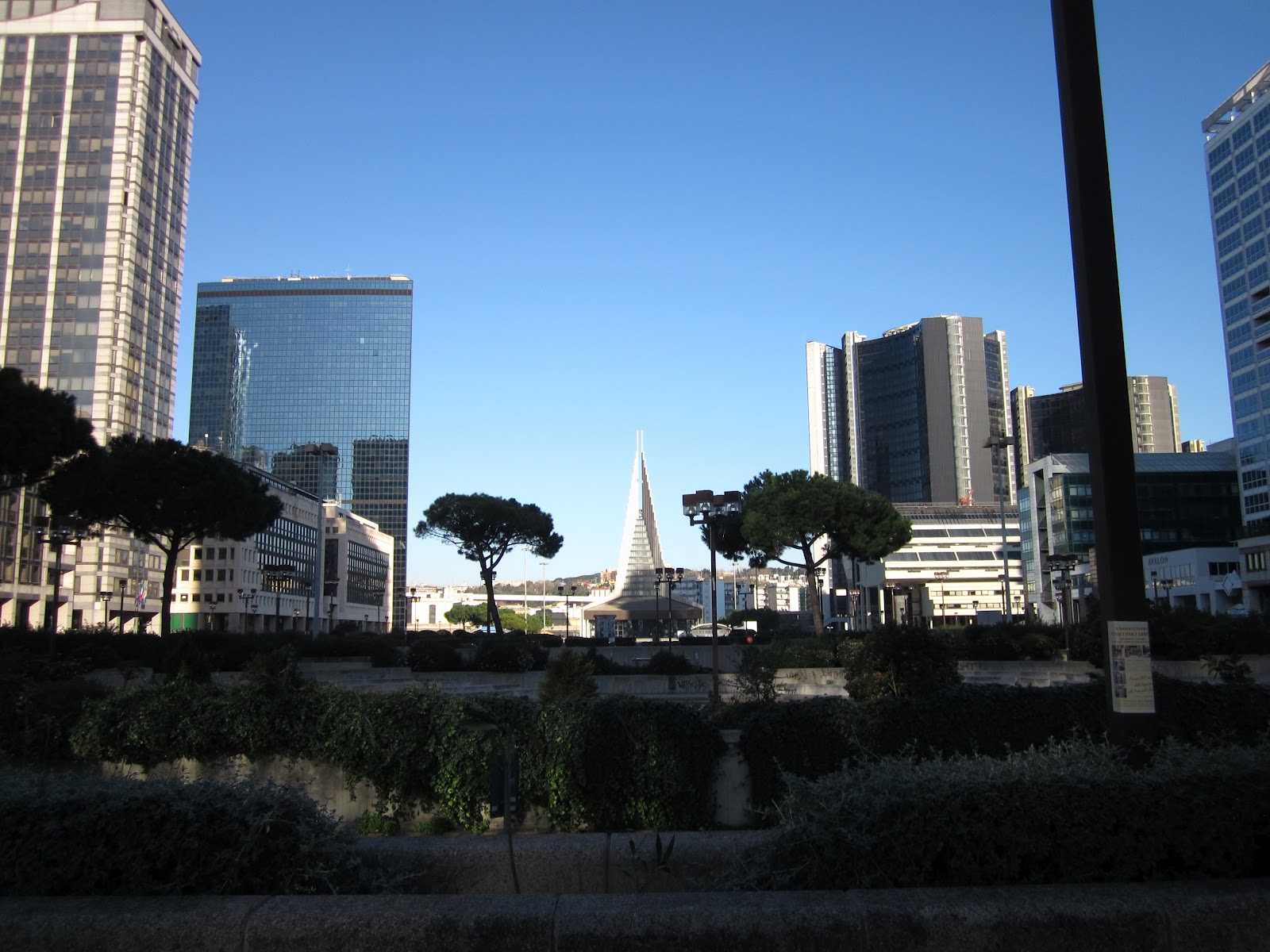
Naples - December 31, 2011 - Centro Direzionale

Looking north-west in the Centro Direzionale. The north
Enel Tower can be seen on the far left.
Just to the north of the train station is “Modern Naples”, in actuality known as the Centro Direzionale.

Funnily enough it covers a smaller area than the train station and rises out of the center of Naples like a phoenix from the ashes of a million burger wrappers.


To be perfectly frank, I think it looks like one of those western American cities, the ones built on the plains in the shadows of mountains. Like Denver or Calgary, where all of the tall buildings are huddled together, clinging close as if they are afraid of their surrounding suburbs. In the case of Naples this just might be true.

The Centro Direzionale is the administrative hub of Naples, and many of the buildings are local or national government organizations. National Italian corporations also make their southern home here, with Telecom Italia occupying the tallest building in southern Italy.

Stark, clean-ish (just don’t look at the escalators) and modern (but a little dated) the area lacks any and all of the enchantment of Naples proper. It makes up for this by being in a high crime area and bordered on the north by the largest prison in Italy and on the south by the train station. The prison is rather fascinating, being of the nineteenth century type with the addition of brushed metal gun turrets. It also seems appropriate to build the new city hall, law and government offices so close to the prison, considering that is usually where Italian (and other nations too) politicians tend to live when they are not in office.


Looking east into the Centro Direzionale from the Enel Towers

The district starts with a dramatic entrance from the old city framed by the twin Enel towers, each 400 feet tall which form a gateway into this strange and alien landscape (at least strange and alien compared to the rest of Campania). It’s all very shiny.

Enel Towers looking west with old Naples beyond
 We visited on a Saturday so the district was understandably empty. this had the effect of upping the creepiness factor from abandoned Victorian house to "Collection of headless manikins dressed in bloodstained formal wear...in an unfinished basement...lit by one bare flickering light bulb...swinging back and forth...". Actually the quiet was kind of nice.

View from eastern end of the Centro Direzionale looking north toward modern church and prison
The whole area is designed on a pair of axis very much like the nave of a church and the transepts.  The vistas are impressive with their little "Leonardo trees" poking up all over the landscape.

In another reference to Leonardo da Vinci there is a large spherical sculpture made out of a sort of 3D mosaic of various marbles. In the center is a rendering of da Vinci's famous "Man in His Perfect Proportions", it was quite worth the trip into the district for that alone.

3D mosaic sphere with rendering of "Man in His Perfect Proportions"


Monday, July 23, 2012

Naples - December 31, 2011 - Albergo Dei Poveri

We were thwarted on our attempt to go to the Palace of Caserta by the Italian train system, but no matter, I had built in fail-safes for this very eventuality. Our first stop that day was the Albergo dei Poveri a poor/work house begun by King Charles II (Bourbon) in 1749, while he was actually building the Palace of Caserta.

The walk from the train station took about twenty minutes and passed through not the best neighborhoods of Naples. Each street and piazza had it's own charm or character. The area closer to the Albergo and further from the Centro Direzionale and Centro Historico had a little more character than might normally be desired. In fact if it were a character in a movie (say circa 1920) it would have been hiding behind a tree twiddling it's mustache waiting to tie Mary Pickford to the train tracks.  Believe me I know that I am very privileged to be able to visit Naples and I can't complain, but I have never seen that much canine fecal matter on a single stretch sidewalk, ever, not even in Paris. I eventually stopped looking at the sidewalk realizing that stepping in some was inevitable.

The Albergo dei Poveri (also known as the Bourbon Hospice for the Poor) immediately impresses with its tremendous size and brilliant whiteness.  The thing that impresses the most is that only one side of the building was actually built. The original plans called for a gigantic building with five courtyards, a chapel and a facade of 1,900 feet (about 600 meters). As it is the building stretches for 1,000 feet down the Via Foria with its large portal and pediment centered on the Piazza Carlos II. Which is not a delightful square, but is very much part of Naples as lived in by Neopolitans.  There was a little hole in the wall market, a couple of cafes and a bar or two, plus plenty of palm trees.

The building has been restored in recent years and is now used for various exhibitions (most recently Gunther von Hagens Body Worlds. I saw his Body World & The Brain in Portland, Oregon earlier this year, still not sure, I thought it was a little "artistic" and working in a medical university I was expecting something a little more clinical.). 


Albergo dei Poveri looking North along the Via Fiori. The Orange letters are the sign for the Napoli Teatro Festival Italia
Yes it is supposed to look like that...

The most awesome building ever! On the VIa Fiori and Piazza Carlos II across the street from the Albergo dei Poveri